7 Powerful Signs You Have Money Blocks (And Why Affirmations Alone Won’t Clear Them)
Jun 3, 2026

If you've ever stared at your bank account and thought:
"I know better than this."
"I've done the mindset work."
"I've repeated the affirmations."
"So why does money still feel hard?"
You're not alone.
In fact, this is one of the most common frustrations among spiritually aware women who have invested years into personal growth.
They've read the books.
They've created the vision boards.
They've journaled about abundance.
They've practiced gratitude.
Yet somehow, the same financial patterns keep showing up.
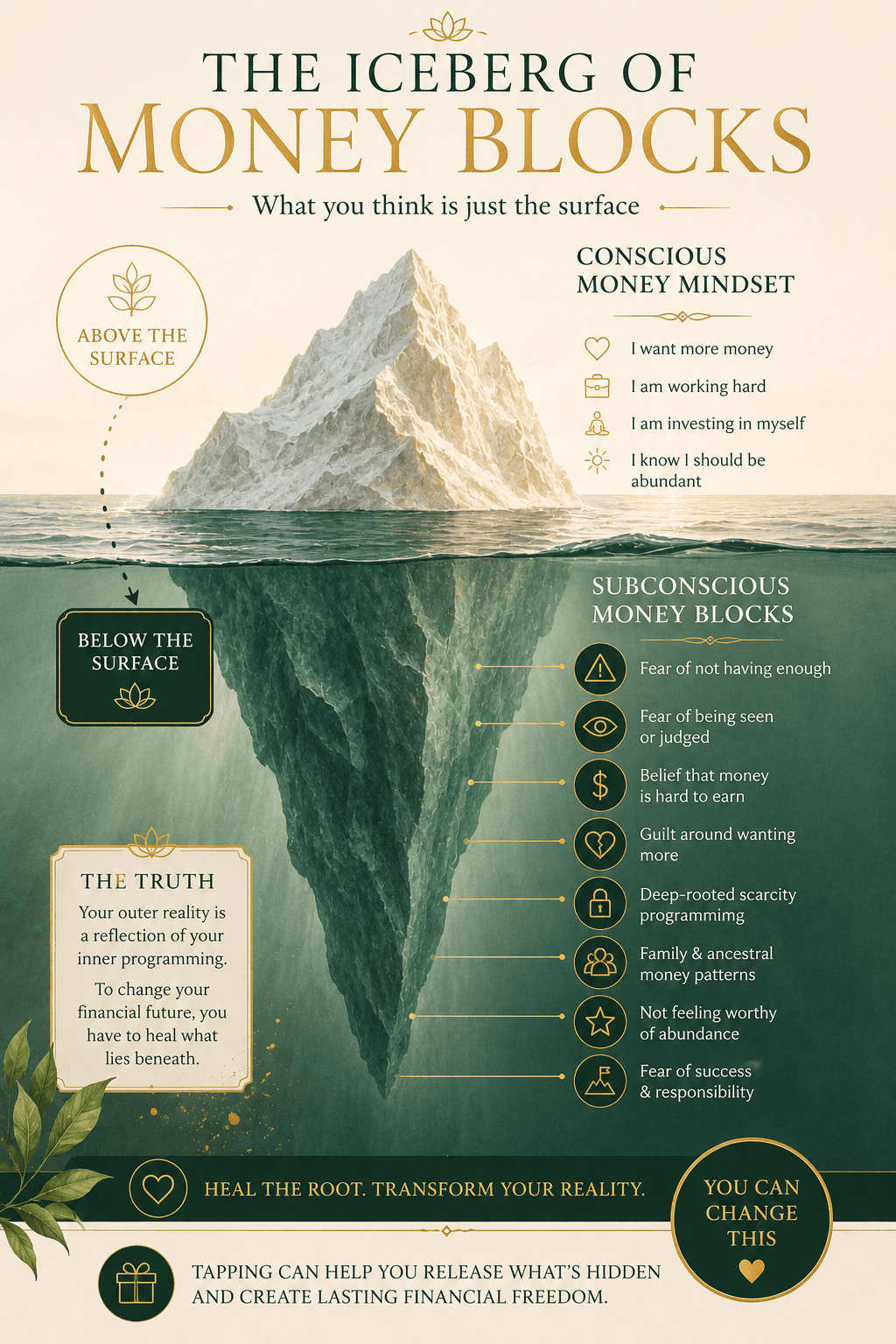
The truth is that money blocks are often far deeper than conscious thoughts.
You can believe that you're worthy of abundance and still feel anxious every time you send an invoice.
You can know that money isn't evil and still panic when more visibility comes your way.
You can want success while simultaneously feeling unsafe receiving it.
This is where understanding limiting beliefs about money through a nervous-system lens changes everything.
Let's explore why.
What Are Money Blocks?
At their core, money blocks are unconscious emotional, psychological, and nervous-system patterns that interfere with your ability to receive, keep, or grow money.
They often operate below conscious awareness.
This is why so many intelligent, capable women find themselves repeating the same financial experiences despite knowing exactly what they "should" do.
A money block is not a lack of intelligence.
It is not laziness.
It is not a lack of ambition.
It is usually a protective adaptation your body learned at some point in your life.
When your nervous system associates money with danger, judgment, rejection, conflict, responsibility, visibility, or loss, it may unconsciously resist the very thing you consciously desire.
Why Positive Affirmations Often Aren't Enough
This is where many personal development teachings unintentionally leave people feeling broken.
Imagine someone who is terrified of public speaking.
If they repeat:
"I am confident."
"I am safe."
"I love speaking."
Their conscious mind may agree.
But if their body still perceives visibility as dangerous, the nervous system wins.
Money works the same way.
Many women struggling with money mindset challenges aren't lacking positive thoughts.
They're carrying unresolved emotional patterns.
Their body may still believe:
Success isn't safe.
More money creates more problems.
Rich people are judged.
Visibility leads to criticism.
Receiving creates guilt.
Affirmations speak to the conscious mind.
But many money blocks live in the subconscious and the body.
This explains why affirmations can feel inspiring for a few minutes but fail to create lasting change.
The Missing Piece: Your Nervous System
One of the most important developments in modern healing is understanding how the nervous system influences behavior.
When the body feels unsafe, it prioritizes protection over growth.
This can show up as:
Procrastination
Undercharging
Avoiding money conversations
Self-sabotage
Fear of visibility
Difficulty receiving support
The challenge isn't motivation.
It's safety.
Many forms of financial healing begin when we stop asking:
"What's wrong with me?"
And start asking:
"What is my nervous system trying to protect me from?"
That question changes everything.
7 Powerful Signs You May Have Money Blocks
1. You Constantly Undercharge
You know your work creates results.
You know your prices are low.
Yet raising them feels terrifying.
This often points to subconscious fears around worthiness, rejection, or visibility.
2. Money Creates Anxiety Even When You're Stable
Some women feel stress around money regardless of how much they earn.
This often reflects deeper survival programming rather than current reality.
3. You Avoid Looking at Your Finances
If checking your bank account feels emotionally overwhelming, there may be underlying shame, fear, or avoidance patterns at play.
4. You Feel Guilty Wanting More
One of the most common limiting beliefs about money is the idea that wanting more somehow makes you selfish.
Many women carry this belief without realizing it.
5. You Self-Sabotage Growth Opportunities
Have you ever:
Delayed launching?
Ignored leads?
Avoided promotion?
Sometimes what looks like procrastination is actually protection.
6. You Struggle to Receive
Receiving compliments.
Receiving support.
Receiving money.
Receiving opportunities.
These are often connected.
The ability to receive abundance safely is a skill many women were never taught.
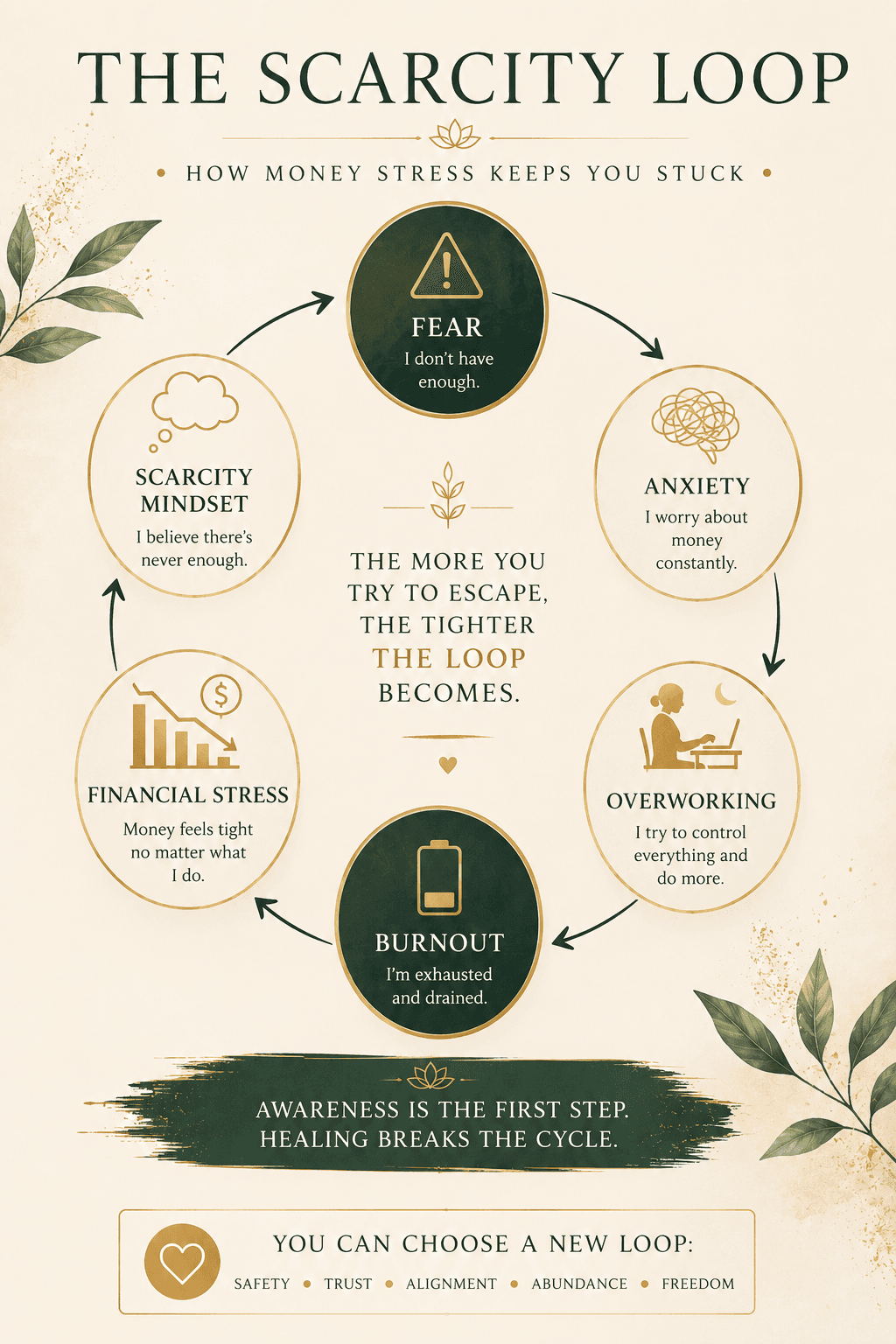
7. You Feel Stuck in Scarcity No Matter What You Do
This is one of the clearest signs of a scarcity mindset operating beneath conscious awareness.
The mind says:
"There is enough."
The body says:
"What if there isn't?"
Where Do Money Blocks Come From?
Many money blocks originate from experiences that had little to do with money itself.
Common sources include:
Childhood Conditioning
Hearing:
"Money doesn't grow on trees."
"People like us struggle."
"Rich people are greedy."
Family Loyalty
Feeling guilty about surpassing parents or siblings financially.
Religious or Cultural Beliefs
Associating wealth with selfishness or moral compromise.
Past Experiences
Financial stress, instability, rejection, or criticism.
Ancestral Patterns
Many people are now exploring how inherited family stories influence financial behavior across generations.
Regardless of the source, the body learns patterns designed to keep us safe.
Unfortunately, those same patterns can later keep us stuck.
Why EFT Tapping Works Differently
This is where EFT tapping for money can be incredibly powerful.
Unlike traditional mindset work alone, EFT combines focused awareness with gentle tapping on acupressure points.
This process may help reduce emotional intensity around limiting beliefs, fears, and stored stress responses.
Rather than forcing positivity, EFT creates space for emotional honesty.
For example:
Instead of saying:
"I am a money magnet."
You might begin with:
"Even though part of me feels unsafe receiving more money, I deeply and completely accept myself."
This approach often feels far more believable to the nervous system.
And lasting change usually begins with honesty, not denial.
Many women exploring EFT tapping for money, how to clear money blocks, and ancestral money trauma healing discover that healing happens when the body finally feels safe enough to let go of old protective patterns.
A New Way to Think About Abundance
The goal isn't to become someone new.
The goal is to remove the unconscious patterns preventing you from being fully yourself.
Abundance is often less about becoming worthy and more about realizing you were worthy all along.
The work is not forcing.
The work is unwinding.
The work is creating safety.
And from safety, growth naturally follows.

Final Thoughts
If you've been doing all the "right" things and still feeling stuck, please know this:
You're not broken.
You're not lazy.
You're not failing at manifestation.
You may simply be trying to solve a nervous-system pattern with conscious thought alone.
Understanding money blocks through a body-based lens can be incredibly validating because it explains why effort, discipline, and affirmations sometimes aren't enough.
Healing becomes easier when we stop fighting ourselves and start listening to what our body has been trying to tell us all along.
Ready to Go Deeper?
If this resonated, the 365 EFT Money Blocks Guide gives you a full year of done-for-you tapping statements—organized by theme so you always know exactly where to start.
Just $7, instant download.

Reader Reflection
Which money pattern do you recognize most in yourself?
Undercharging?
Money anxiety?
Scarcity mindset?
Fear of visibility?
Difficulty receiving?
Share your thoughts in the comments below.
And if you found this article helpful, save it for your next tapping session and share it with someone who needs to hear this today.
References
Gabor Maté, MD – The Myth of Normal
Stephen Porges, PhD – Polyvagal Theory
Dawson Church – EFT and Emotional Freedom Techniques Research
National Center for Complementary and Integrative Health (NCCIH)
The Association for Comprehensive Energy Psychology (ACEP)