7 Proven Steps to Clear Money Blocks With EFT Tapping: A Beginner's Complete Guide
May 28, 2026

You have done the work. The journaling, the courses, the affirmations on your mirror. You know, intellectually, that you are worthy of abundance. You know your services have value. You know you deserve to be paid well.
And yet — something stops you. Every time.
You discount your prices before anyone even asks. You feel a quiet dread when you open your banking app. Money arrives and somehow slips away before it can settle. You watch other people, with what looks like half your talent, earning twice your income, and wonder what invisible wall you keep running into.
Here is what that wall actually is: it is not a mindset problem. It is a nervous system problem. And that distinction changes everything about how you heal it.
EFT tapping for money blocks — also called Emotional Freedom Technique — is a clinically researched, body-based practice that works at exactly that level. Not at the level of thoughts, but at the level of the stored survival patterns that run beneath your thoughts. This guide is going to walk you through exactly what it is, why it works when everything else has not, and how to start clearing your own money blocks today — step by step, point by point.
No spiritual bypassing. No toxic positivity. Just the real mechanism, the actual science, and a complete practice you can use right now.
Why Your Money Blocks Live in Your Body, Not Your Brain
Before we get into how to do EFT tapping for money blocks, it is worth understanding why this approach works when affirmations and mindset shifts often do not — and why that is not your fault.
Most money healing tools work at the level of the conscious mind. Journaling, visualization, positive thinking — these are all cortex-level interventions. They are valuable. But they address the 5% of your mind that is conscious, while your money blocks live in the other 95%: the subconscious programs, the nervous system patterns, the body memories formed long before you were old enough to have a philosophy about wealth.
When you grew up hearing "money doesn't grow on trees," or watched your parents fight over finances, or belonged to a family or culture where struggle was normalized and abundance was suspect — your body learned something. It learned that financial scarcity equals belonging. That earning more means outgrowing the people you love. That visibility brings danger. That money and safety cannot coexist.
These are not beliefs you can think your way out of. They are somatic survival programs. And they are running right now, underneath your best intentions.
This is why tapping for abundance reaches a different level. By combining focused psychological acknowledgment with gentle acupressure on the body's meridian points, EFT communicates directly with the part of your brain that holds these patterns — and begins to release them.
What EFT Tapping Actually Is (And Why the Science Is More Solid Than You Think)
EFT stands for Emotional Freedom Techniques. It was developed in the 1990s by Gary Craig, building on Dr. Roger Callahan's Thought Field Therapy, and has since accumulated over 300 peer-reviewed studies supporting its effectiveness across anxiety, trauma, PTSD, phobias, chronic pain, and — crucially for our purposes — stress and limiting beliefs.
Here is the basic mechanism: you tap with two fingers on specific acupressure points on the face and upper body, while holding a specific thought, feeling, or belief in mind. The tapping sends a calming signal to the amygdala — the brain's threat-detection center — while simultaneously processing the emotional charge around the thought.
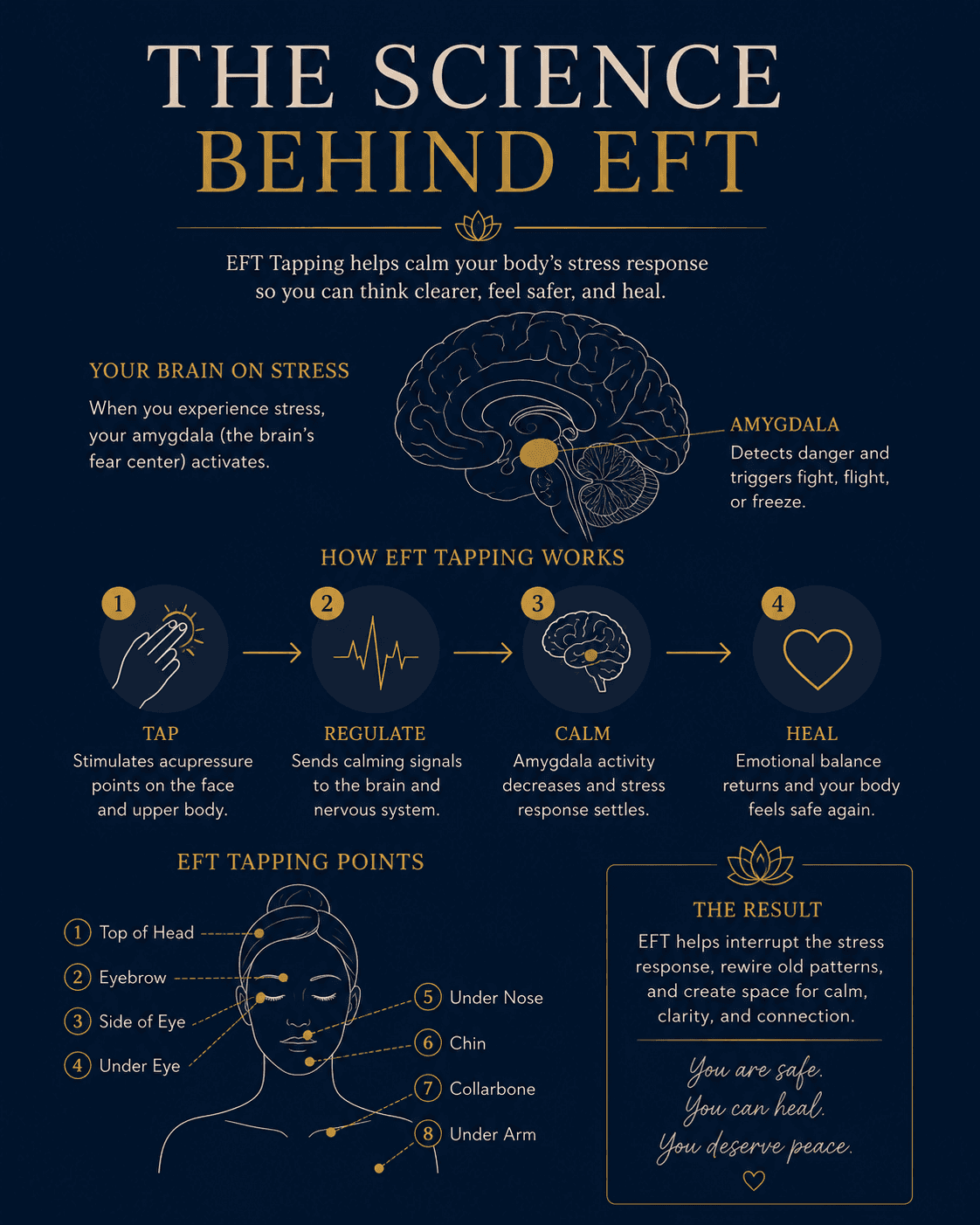
Two specific research findings matter enormously for money blocks:
Cortisol reduction: A landmark study published in the journal Psychological Trauma (Church et al., 2012) found that a single EFT session produced an average 24% reduction in cortisol — the body's primary stress hormone. A separate meta-analysis (Sebastian and Nelms, 2017) documented a mean cortisol decrease of 43% across multiple EFT studies. When your body is flooded with cortisol, the prefrontal cortex — responsible for calm decision-making, risk tolerance, and creative problem-solving — goes offline. Financial anxiety literally impairs your ability to think clearly about money. EFT interrupts that cycle at the hormonal level.
Amygdala deactivation: fMRI studies show that EFT tapping decreases activation in the amygdala and hippocampus — the areas responsible for the fear response and for consolidating fear memories. When these are calmed, the nervous system can finally receive new information. Abundance stops feeling like a threat.
This is why EFT tapping for money blocks works when affirmations feel hollow — it is not asking your conscious mind to perform a new belief. It is asking your nervous system to release an old fear.
The 10 EFT Tapping Points You Need to Know
Before you can begin clearing money blocks with EFT, you need to know where to tap. There are 10 main points used in a standard EFT sequence. Use two fingers — your index and middle — and tap each point 5 to 7 times with gentle but firm pressure.

Here are the 10 points in tapping sequence order:
1. Karate Chop Point (KC)
Location: The fleshy outer edge of either hand, between the wrist and the base of the little finger. Use: This is where you deliver your Setup Statement — three times, while tapping continuously.
2. Top of Head (TH)
Location: The very crown of your head, center. Use: Begin your tapping round here after completing the setup.
3. Eyebrow (EB)
Location: The inner edge of the eyebrow, just above and to the side of the nose.
4. Side of Eye (SE)
Location: On the outer corner of the eye socket, on the bone.
5. Under Eye (UE)
Location: On the bony ridge directly below the center of the eye.
6. Under Nose (UN)
Location: The indentation between the base of the nose and the upper lip.
7. Chin (CH)
Location: The crease between the lower lip and the chin.
8. Collarbone (CB)
Location: Just below the inner end of the collarbone — tap both sides simultaneously or alternate.
9. Under Arm (UA)
Location: Approximately four inches below the armpit, roughly level with the bra strap.
10. Wrist (WR)
Location: Inner wrists tapped together, completing the round.
The full sequence: KC (Setup) → TH → EB → SE → UE → UN → CH → CB → UA → WR → repeat.
You do not need to be precise to the millimeter. The meridian points cover a general area, and your intention matters as much as exactness. Relax. You are allowed to get this imperfectly right.
The EFT Setup Statement Formula — This Is Where the Real Healing Happens
The Setup Statement is the soul of EFT. It is what separates tapping from simple acupressure — and it is what makes EFT tapping for money blocks so much more powerful than affirmations alone.
The classic formula is:
"Even though [the block / feeling / belief], I deeply and completely accept myself."
This two-part structure is doing something psychologically sophisticated. The first part — naming the block — bypasses the inner critic's resistance. You are not pretending the problem does not exist. You are not white-knuckling your way to positivity. You are acknowledging the truth of what you feel, which is what actually creates safety in the nervous system.
The second part — "I deeply and completely accept myself" — introduces unconditional self-acceptance as a simultaneous truth. Not because you have fixed anything yet, but because healing requires the nervous system to feel safe enough to change.
Together, these two statements say: This is real. And I am still okay. That is the shift that makes the nervous system willing to let go.

Some examples relevant to your specific situation:
If you undercharge: "Even though I feel unsafe asking for what I am worth, I deeply and completely accept myself."
If money feels spiritually wrong: "Even though I believe wanting money makes me less spiritual, I deeply and completely accept myself."
If your family's patterns run deep: "Even though I am carrying my family's relationship with money in my body, I deeply and completely accept myself."
If visibility feels dangerous: "Even though being seen earning money feels unsafe, I deeply and completely accept myself."
Notice that none of these ask you to pretend the feeling is not there. They meet you exactly where you are. That is the precision that makes this work.
Your First Full EFT Tapping Session for Money Blocks — Step by Step
This is a complete tapping sequence you can use right now. Give yourself 10 quiet minutes. Find a comfortable seat.
Step 1: Choose Your Focus
Before you tap, get specific about what you want to work on. Clearing money blocks is more effective when you work on one specific feeling at a time rather than "all my money stuff." Pick the one that feels most alive in your body right now.
Some starting points:
I feel anxious when I look at my bank account
I struggle to charge what my work is worth
I feel guilty when money comes in easily
I carry my mother's / father's / family's beliefs about money
Step 2: Rate Your Intensity (The SUDS Scale)
On a scale of 0 to 10 — where 0 is completely neutral and 10 is maximum distress — how activated do you feel when you hold this issue in mind? Note your number. You will re-check it after tapping to measure your shift.
This is not a test. It is a compass.
Step 3: The Setup Statement (Karate Chop Point, 3 Times)
Tap continuously on the Karate Chop point and say your setup statement three times:
"Even though I feel this anxiety about money in my body, and I have carried it for a long time, I deeply and completely accept myself."
"Even though I learned that money is hard to come by, and that belief is stored somewhere in me right now, I choose to be gentle with myself."
"Even though my nervous system does not feel safe with financial ease, I honor how I feel and I deeply and completely accept myself."
Step 4: The Tapping Round — Releasing Statements
Now move through each point, 5 to 7 taps each, while saying these reminder phrases:
Top of Head: This anxiety about money Eyebrow: I learned to worry about money Side of Eye: It never feels like enough Under Eye: This tightness in my chest around finances Under Nose: What if money is not really safe for meChin: I am afraid to let myself want more Collarbone: This pattern is stored in my body Under Arm: And it has been here for a long time Wrist: I am ready to start releasing it
Take a slow breath. Check your number on the 0-10 scale. Has it shifted?
Step 5: The Pivoting Round — Introducing Possibility
Stay at the Karate Chop point. Take one breath. Then move through the points again with these statements:
Top of Head: What if money could feel safer Eyebrow: What if ease does not have to be earned through struggle Side of Eye: What if my nervous system is learning something new Under Eye: What if I am allowed to receive Under Nose:What if abundance and integrity can coexist Chin: What if I can hold money without losing myself Collarbone: My body is starting to remember safety Under Arm: I am open to a new relationship with money Wrist: I am safe, and I am healing
Take a full, conscious breath. Place one hand on your heart. Notice what has shifted.
Step 6: Rate Yourself Again
What is your number now? Most people find it drops 2 to 5 points in a single round. If it has not moved much, that is information — the block may have roots in a different direction. Try a more specific setup statement about what came up during tapping.
If it dropped, wonderful. You have just experienced what tapping can do. This is one round. Imagine what a consistent daily practice — over weeks, months, a year — can shift.
Step 7: Close Your Session
End every tapping session by placing both hands on your heart, taking three slow breaths, and saying aloud: "I am safe. I am healing. Money can flow to me gently and steadily."
This closes the nervous system loop and anchors the session.
The 7 Most Common Money Blocks and Which Theme to Tap On
One of the reasons EFT tapping for money blocks can feel overwhelming for beginners is not knowing where to start. There are so many layers to a complicated money story. Here is a map of the most common blocks and the emotional root underneath each one:

1. Scarcity and Survival Fear
Symptom: Constant anxiety about not having enough, even when objectively stable. Root: The nervous system learned early that money = survival, and survival was uncertain. Tap on: "Even though my body is still bracing for financial disaster..."
2. Self-Worth and Deserving
Symptom: Undercharging, over-delivering, chronic discounting of your value. Root: The belief — often inherited — that you do not deserve financial ease. Tap on: "Even though I do not feel worthy of being paid what my work is worth..."
3. Visibility and Exposure
Symptom: Hesitation to promote your work, fear of being seen, shrinking when it comes to money conversations. Root: Visibility was associated with danger, judgment, or attack at some formative point. Tap on: "Even though being seen earning money feels unsafe in my body..."
4. Ancestral and Family Loyalty
Symptom: Fear of out-earning your parents, guilt at doing better than siblings, feeling like financial success means leaving your roots behind. Root: Unconscious loyalty to the financial identity of your lineage. Tap on: "Even though earning more feels disloyal to the people I love..."
5. Money and Spirituality Conflict
Symptom: The deep conviction that wanting money makes you less spiritual, less good, or less pure — especially common among healers, coaches, and creatives. Root: A conflation of wealth with greed, often reinforced by religious or cultural conditioning. Tap on: "Even though I believe money and my spiritual path cannot coexist..."
6. Fear of Success
Symptom: Self-sabotage just as things get good — a launch that fizzles, an invoice that gets delayed, an opportunity that mysteriously falls through. Root: Success was unconsciously associated with danger: being seen, being responsible, being resented. Tap on: "Even though success feels unsafe somewhere in my body..."
7. Receiving and Holding Money
Symptom: Money arrives and immediately disappears — unexpected bills, sudden spending, giving it away before it can land. Root: The body does not feel safe holding abundance — it feels too exposed, too responsible, too unfamiliar. Tap on: "Even though I do not trust myself to hold money..."
How Often Should You Tap, and What Should You Expect?
This is one of the most important questions beginners ask about tapping for abundance, and the honest answer is: it depends on the depth of the roots.
A practical starting framework:
Daily tapping (5-10 minutes): This is the sweet spot for most people. Choose one statement per day, rate your intensity, tap through 2-3 rounds, close with the positive statements. Over 30 days, most people notice measurable shifts in how their body feels when they think about money — less bracing, less dread, more openness.
Intensive sessions (20-30 minutes): When something specific has been triggered — a difficult client conversation, a surprising bill, a moment of financial shame — a longer session helps process and release what has been activated.
What to expect: In the first few sessions, you may feel emotional — sometimes unexpectedly so. This is the nervous system releasing stored charge. It is normal and healthy. You may also feel tired afterwards, or lighter, or notice physical sensations like yawning, sighing, or warmth. These are all signs that something is moving.
What will shift over time: the background hum of financial anxiety becomes quieter. Charging your worth feels less physically threatening. Talking about money becomes more neutral. Receiving compliments, clients, and income starts to feel safer in your body — not just in your head.
This is not magic. It is biology. And it is available to you.
A Note on Consistency: Why One Year of Daily Tapping Changes the Game
The nervous system learns through repetition. The same way your money blocks were installed through repeated exposure to certain messages, environments, and experiences — they are released through repeated exposure to safety, acknowledgment, and new possibility.
A single tapping session can shift the intensity of a specific block significantly. A year of daily tapping — working systematically through every dimension of your money story — is genuinely transformative.
That means 365 individual opportunities to meet yourself where you are. To say: this belief is real in my body, and I am still worth accepting. To systematically clear the scarcity, the shame, the loyalty patterns, the spiritual conflicts, the identity resistance — one session at a time.
The challenge most people face is knowing what to tap on. It is easy to start strong and then run out of ideas, or keep circling the same few statements without reaching deeper layers.
This is exactly why a structured, themed guide makes such a difference.

If this guide resonated, you are probably realizing that your money blocks have more layers than a single tapping session will reach — and that a consistent, organized practice is what creates lasting change.
The 365 EFT Money Blocks Guide gives you a full year of done-for-you tapping setup statements, organized across 73 healing themes — from scarcity and nervous system safety, to ancestral patterns, spiritual guilt, identity shifts, and embodied wealth. So you always know exactly what to tap on, and you never lose momentum.
Just $7. Instant download. One statement a day for an entire year of financial healing.
Get the 365 EFT Money Blocks Guide here.
5 Common EFT Tapping Mistakes Beginners Make (and How to Avoid Them)
Mistake 1: Being Too Vague
"Even though I have money issues..." will not create the same shift as "Even though I feel a tight knot in my stomach when I think about sending my invoice." Specificity is what allows the amygdala to locate and release the stored charge. The more precise your language, the more effective your EFT tapping for money blockswill be.
Mistake 2: Skipping the Rating Scale
It is tempting to skip the 0-10 rating — it feels clinical in a practice that is emotional. But the SUDS scale (Subjective Units of Distress) is important because it gives you evidence that the tapping is working. When you see your number drop from an 8 to a 3, it builds trust in the process and keeps you consistent.
Mistake 3: Tapping on Too Many Things at Once
If you sit down and try to tap on "all my money stuff," the session will feel scattered and less effective. Choose one specific feeling, belief, or memory per session. You will go deeper and get clearer results.
Mistake 4: Stopping When Emotions Rise
If tears come, or anger surfaces, or a memory appears — that is the clearing happening. The instinct is to stop. The practice is to continue, gently, through the emotion. You do not have to dramatize it. Stay with it, keep tapping, and let it move through.
Mistake 5: Expecting Overnight Results for Deep Roots
Clearing money blocks that have been stored in the nervous system for 20 or 30 years takes time. One session can shift the intensity of a specific belief dramatically. Shifting the underlying pattern requires consistent practice. Be patient with yourself. You are doing something genuinely brave.
Frequently Asked Questions About EFT Tapping for Money Blocks
Does EFT tapping actually work for money blocks, or is it just placebo?
The research is more robust than most people realize. Over 100 randomized controlled trials have now been published on EFT, showing significant effects on cortisol, anxiety, PTSD, and phobias. While fewer studies focus specifically on financial beliefs, the underlying mechanism — amygdala calming through acupressure while cognitively processing a stressor — applies equally to money anxiety as to any other fear response. The outcomes reported by consistent practitioners are well-documented: reduced financial anxiety, increased willingness to charge higher rates, improved tolerance for financial uncertainty, and measurable behavior change around money.
How long does it take for EFT tapping to work on money blocks?
Most people notice a shift in the intensity of a specific belief within a single session. For deeper, more entrenched patterns — particularly those rooted in childhood or ancestral experience — consistent daily practice over 30 to 90 days produces the most significant and lasting change. The nervous system learns through repetition, so frequency matters more than session length.
Can I use EFT tapping for money blocks even if I have never tried tapping before?
Yes. EFT was specifically designed to be accessible without prior training. The sequence in this guide is everything you need to begin. Beginners often experience significant shifts in their very first session, precisely because they have no preconceptions to override.
Do I need to believe the setup statement for EFT to work?
No — and this is one of the most liberating truths about EFT. You do not need to believe the statement. You need only to be willing to say it. The tapping works at the level of the nervous system's stress response, not at the level of conscious agreement. Many people find that after several rounds, they begin to feel the possibility in statements they initially found impossible.
What is the difference between EFT tapping and affirmations?
Affirmations work at the level of the conscious mind — they ask you to install a new belief through repetition. EFT works at the level of the body — it first releases the stored charge around the old belief, creating genuine space for new patterns. This is why EFT often succeeds where affirmations feel hollow: you are not trying to override the old program, you are dismantling it at its roots.
Can EFT tapping help with undercharging and pricing anxiety?
Yes — and this is one of the most common and powerful applications for tapping for abundance among coaches, healers, and creatives. The fear of charging your worth is almost never a strategic problem. It is a somatic one: the body registers visibility, judgment, and financial power as threats. EFT addresses that body-level fear directly, making it progressively safer to communicate and hold your real value.
How many EFT tapping sessions does it take to clear money blocks completely?
There is no universal answer, because money blocks vary enormously in depth, origin, and complexity. A single surface-level anxiety (like nerves before a sales call) might resolve in one or two sessions. Deep ancestral patterns, identity-level resistance, or money trauma connected to significant life events may take months of consistent tapping to fully resolve. Most practitioners recommend approaching money healing as a year-long practice rather than a quick fix.

You Have Always Been Worthy of Financial Ease
The money blocks you carry are not character flaws. They are not evidence that you are bad at abundance, or spiritually unaligned, or fundamentally broken. They are learned survival responses — and learned patterns can be unlearned.
EFT tapping for money blocks gives you a way to meet those patterns where they actually live: in your body, in your nervous system, in the subconscious programs that run silently beneath your best intentions. You do not have to fight them. You do not have to perform your way past them. You simply tap, acknowledge, and release — one session, one belief, one day at a time.
That is how real change happens. Gently. Consistently. From the inside out.
Ready to go deeper? The 365 EFT Money Blocks Guide gives you a full year of done-for-you setup statements — 73 healing themes, 365 statements, organized so you always know exactly where to start. Just $7, instant download. Because you deserve a complete, consistent practice — not just a single session.
References and Further Reading
Church, D., Yount, G., & Brooks, A. J. (2012). The effect of emotional freedom techniques on stress biochemistry. Journal of Nervous and Mental Disease, 200(10), 891-896.
Sebastian, B., & Nelms, J. (2017). The effectiveness of Emotional Freedom Techniques in the treatment of posttraumatic stress disorder: A meta-analysis. EXPLORE: The Journal of Science and Healing, 13(1), 16-25.
Clond, M. (2016). Emotional Freedom Techniques for anxiety: A systematic review with meta-analysis. Journal of Nervous and Mental Disease, 204(5), 388-395.
Stapleton, P., et al. (2019). Neural changes after Emotional Freedom Techniques treatment for chronic pain sufferers. Complementary Therapies in Clinical Practice, 35, 72-79.
Association for Comprehensive Energy Psychology (ACEP): www.energypsych.org
The EFT Universe research database: www.eftuniverse.com/research-and-studies